From your very first question to years of comfortable wear.
Here's what to expect at every step.
If you're reading this, you may be preparing for surgery, recovering from it, or simply trying to understand what comes next. Wherever you are in this process, we want you to know exactly what to expect. No surprises, and no medical jargon.
Every patient's path is slightly different, but the journey below gives you a clear picture of how things typically unfold at Kind Eyes. We move at your pace, and nothing happens without you understanding and feeling comfortable with it first.
Progress
Getting in touch
Your journey begins with a conversation, not a commitment. You can reach Lorna by phone, email, or through the contact form on this site. Many patients get in touch before they've even had surgery, and that's perfectly fine.
During this first conversation, Lorna will listen to your situation, answer any immediate questions, and explain what the process looks like for your specific case. If you've been referred by a surgeon or ophthalmologist, that's helpful, but it isn't required. Self-referrals are welcome.
There is no obligation at this stage. Some people need weeks or months before they feel ready to take the next step. That's completely normal.
What to have ready: Any referral letters or clinical notes from your surgeon if you have them. If you don't, that's fine. Lorna can liaise with your medical team directly.
Healing after surgery
If you've had your eye removed through enucleation or evisceration, your surgeon will have placed a clear plastic conformer in your socket during surgery. This conformer stays in place for about four to five weeks to maintain the shape of your socket and eyelids while healing takes place.
During this period, you'll follow your surgeon's aftercare instructions, typically antibiotic drops and keeping the area clean. Some swelling, bruising, and discomfort are normal in the first few days, and your surgical team will provide pain relief.
You don't need to do anything with us during this stage. Once six to eight weeks have passed and swelling has settled, the prosthetic fitting process can begin.
If your conformer falls out during the healing period, don't panic. This isn't an emergency. Simply contact your surgeon's office and they'll arrange to replace it.
If you already wear a prosthesis and are coming to Kind Eyes for a replacement, this step doesn't apply. You'll move straight to the consultation.
Your consultation
This is your first appointment at Kind Eyes. It begins with a detailed review of your medical and surgical history, including the reason for your eye loss or any existing condition. Lorna will gently examine your socket and, if you have a current prosthesis, assess its fit and condition.
This is also the appointment where you ask everything. How long will the process take? What will it feel like? What can you realistically expect? Before you leave, you'll have a clear step-by-step plan covering your next appointments and what happens at each one.
The consultation is unhurried. Expect it to last around an hour. Lorna will explain everything in plain language and make sure you feel fully informed before moving forward.
What it feels like: Conversational. There's no equipment involved at this stage. It's about getting to know you, understanding your needs, and building the trust that will carry through the rest of the process.
The impression
This is where the custom work begins. Lorna takes an impression of your socket using a soft moulding material, similar in texture to dental putty. This captures the exact shape, depth, and contours of your socket so the prosthesis can be made to fit you precisely.
You might feel a brief cool or unusual sensation when the material is placed, but it's temporary and only lasts a few minutes. The process is not painful. Lorna will talk you through every moment so there are no surprises.
The impression is the foundation of everything that follows. A precise mould means a prosthesis that sits comfortably, moves well, and feels natural from the first day you wear it.
What it feels like: Strange, but not painful. Most patients describe it as an odd pressure that's over quickly. If you need a break at any point, just say so.
Artistry and painting
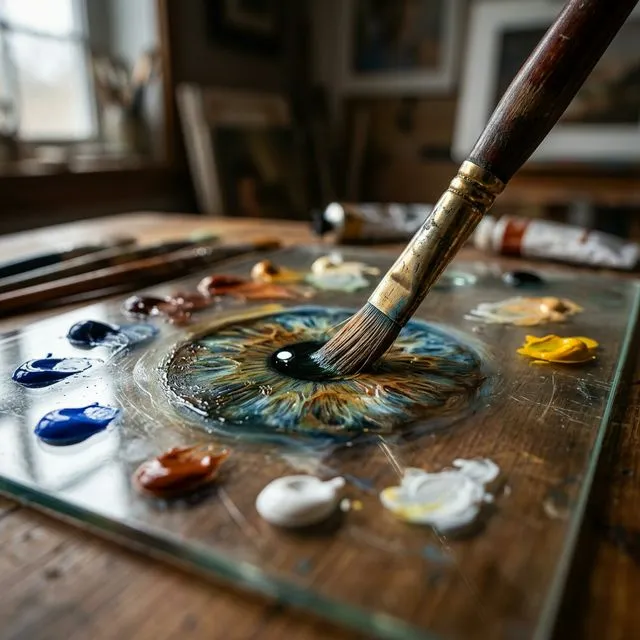
This is where craft meets care. Using your impression as the base, Lorna hand-builds the prosthesis form in acrylic and then paints the iris layer by layer, colour by colour, to match your natural eye.
You are the model and you participate in each step of the design process. Lorna will work alongside you, comparing colours and details against your other eye in real time. You'll see your new eye taking shape and have input throughout. If something doesn't look right to you, it gets adjusted.
The iris painting is fine-art work — matching not just the overall colour but the depth, texture, flecks, and patterns that make your eye uniquely yours. Tiny silk threads are used to replicate the natural blood vessels on the sclera (the white of the eye). A clear acrylic dome is then placed over the iris, mimicking the cornea and adding lifelike depth.
What it feels like: Collaborative and surprisingly fascinating. Many patients find this the most memorable part of the process, watching something deeply personal being created by hand right in front of them.
Fitting and final adjustments
Once the prosthesis has been cured, shaped, and polished to a smooth, glass-like finish, it's time for the fitting. Lorna places the prosthesis in your socket and checks everything: the comfort, the lid closure, the movement, the symmetry against your other eye, and the overall appearance.
Fine adjustments are made on the spot. The shape may be refined, the surface re-polished, or small modifications made to how the prosthesis interacts with your eyelids. The goal is a prosthesis that you can barely feel, that moves naturally with your other eye, and that looks right to both you and Lorna.
You'll also be trained on how to insert, remove, and care for your prosthesis during this appointment. You'll practise until you feel confident doing it on your own. There's no rush; take all the time you need.
What you'll leave with: Your finished prosthesis, the confidence to handle it yourself, and a clear understanding of how to care for it. Most patients walk out feeling a sense of relief and quiet joy that the process is complete.
The first weeks
It's completely normal to feel some fullness or awareness in the socket at first. For most patients, that sensation fades within a few hours as your body adjusts. You shouldn't feel pain. If you do, contact Lorna.
During the first few weeks, you may notice slightly more discharge than usual. This is a normal reaction your body may have to the new prosthesis and typically settles as your socket adjusts.
You can wear your prosthesis day and night from the start. Shower, go to work, see friends — your normal life resumes immediately. If anything feels off or you have questions, Lorna is a phone call away.
What it feels like: Like getting used to a new pair of glasses. You're aware of it at first, then you forget it's there.
Ongoing care
Your relationship with Kind Eyes doesn't end at the fitting. We recommend a professional polish every six months to remove protein buildup and fine surface scratches, and to check that the fit remains comfortable as your socket naturally changes over time.
The average life of a prosthetic eye is around five years, at which point changes in your socket and facial structure may mean it's time for a new one. Lorna will let you know when that point is approaching, so there's never a sudden surprise.
Between appointments, your daily care is simple: lubricating drops as needed, a gentle clean once a month or as advised, and common-sense handling. Full details are on our maintenance guide page.
What it feels like: Routine and reassuring. The six-monthly visits become a normal part of life: a quick check-in that takes around 30 minutes and keeps everything running smoothly.
A note for those not yet ready
Some people visit this page months before they're ready to get in touch. That's completely fine. Bookmark it, come back to it, share it with a family member. When the time feels right, we'll be here.
If you'd like to read about the emotional side of this journey, visit our wellbeing and support resources page. If you have practical questions, our FAQ page and maintenance guide may help.